Wine · Crisis & recovery · Reference page
Phylloxera: the insect that remade the vineyards of the world
In the 1860s a tiny aphid-like insect from North America began killing the vines of France. Within forty years it had reached almost every wine country. The remedy, grafting European vines onto American roots, still holds up most of the world's vineyards.
A plague with no name
The first half of the nineteenth century was good to French wine. Better transport opened markets, and the national vineyard grew from about 1.5 million hectares in 1789 to 2.4 million in 1874. Powdery mildew, a fungus that arrived in 1851, was a setback, but sulphur sprays brought it under control.
Then, in 1863, vines began to die in a way nobody could explain. That year the entomologist J. O. Westwood described an unfamiliar insect on vines in glasshouses near London. At almost the same moment growers at Pujaut, in the Gard, reported dying vineyards close to a nursery known for importing American vines. A second outbreak followed near Bordeaux in 1867, where the grower L. Laliman had been growing American species for some years.
The decline spread outward from these centres. By 1873 it had reached the Drôme, the Var and the Hérault; by 1877 it covered the Bordeaux vineyards from the Médoc to Sauternes; Cognac was hit from 1872. Forty-five French departments were affected in 1880, sixty in 1887 and every wine region by 1900. Champagne was the last.
Finding the culprit
Local growers' associations and politicians called for a field investigation. On 15 July 1868 the vine grower G. Bazille, chairman of the Hérault agricultural society, the Montpellier botany professor J.-E. Planchon and the horticulturist F. Sahut examined dying vines at the Château de Lagoy in the Bouches-du-Rhône and found the insects feeding on the roots. They named it Rhizaphis vastatrix, soon Phylloxera vastatrix, and argued that it caused the decay rather than following it. That point took years to win.
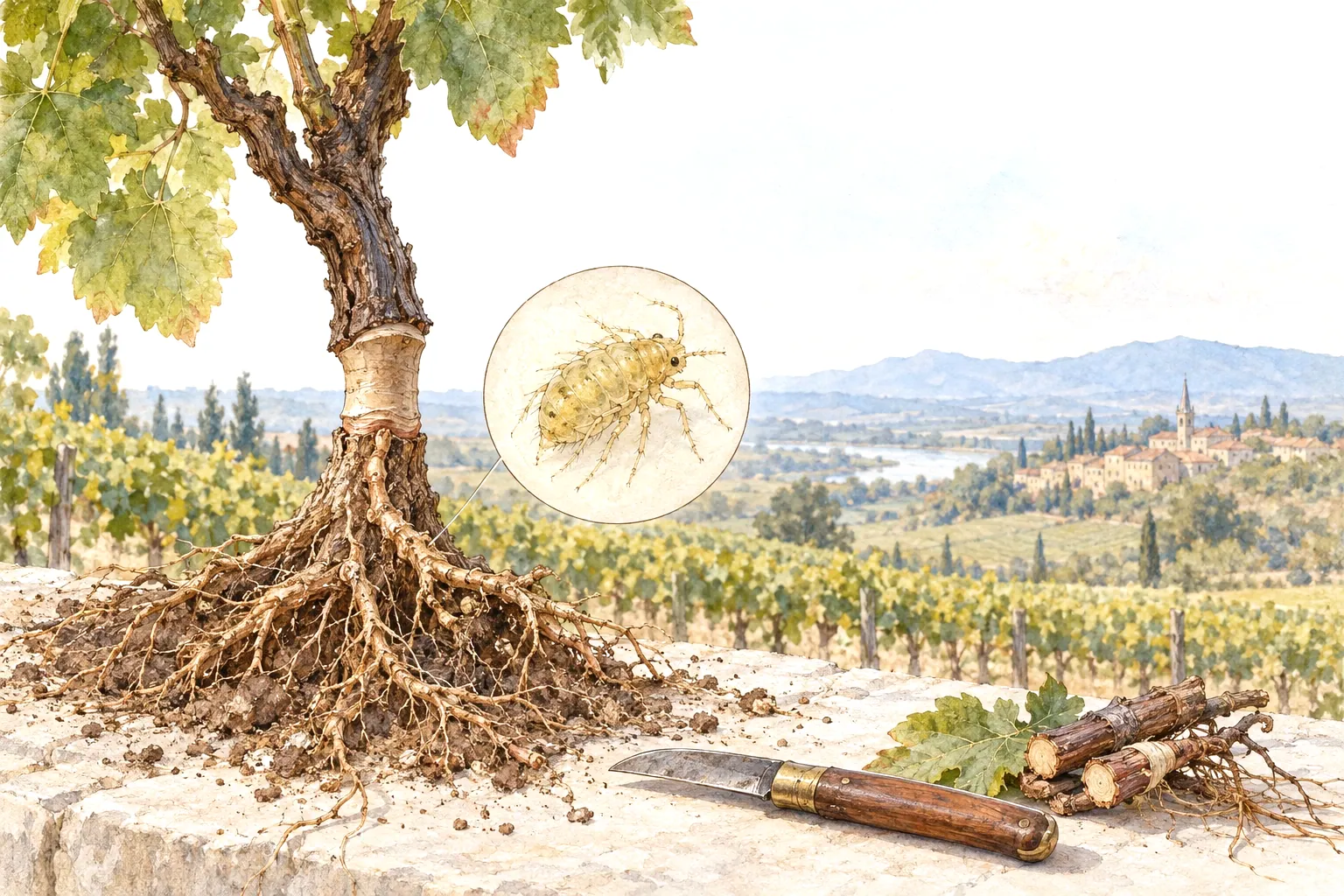
Work on both sides of the Atlantic, by Laliman, Planchon and the American entomologist C. V. Riley among others, showed that the insect was the same one the entomologist A. Fitch had described in New York in 1854 as a gall-forming pest on the leaves of wild American vines. Its accepted name today is Daktulosphaira (also spelled Daktulosphaera) vitifoliae.
The insect had come with the plants. American Vitis species were collected in French botanical gardens early in the century, and imports grew after the 1850s because those vines resisted powdery mildew. In 2020 a team that sequenced the phylloxera genome also compared insect populations around the world: the invasion began in the upper Mississippi River basin, where phylloxera lives on the wild riverbank grape Vitis riparia, spread to Europe and from Europe to the rest of the world.
Chemists, floods and Americanists
In 1870 the French government set up a Superior Commission of Phylloxera and offered prizes. Hundreds of remedies were proposed. The Commission first backed the "sulfurists", who injected carbon disulphide or potassium sulphocarbonate into the soil. The treatment was expensive, dangerous and only partly effective, yet up to about 70,000 hectares were protected this way, mostly in high-value vineyards.
Two other approaches helped. Vines in very sandy soils, with less than about 2 to 3 % clay, survived, and new vineyards were planted on sand. Flooding vineyards in winter to drown the insect, first tried in the south around 1870, was used on more than 37,000 hectares in the Languedoc and around Bordeaux, where water and soil allowed it.
The lasting answer came from the cause itself. American vines lived with phylloxera without dying. Laliman and Bazille suggested grafting European Vitis vinifera onto American roots. The idea met fierce resistance from those who feared American plants would spread the pest further, and laws of 1878 and 1879 restricted their movement. Planchon travelled to the United States in 1873 to study the native vines, and from 1874 A. Millardet of the University of Bordeaux tested which species resisted best. He found V. riparia and V. rupestris highly resistant at the root; V. berlandieri, valued for chalky soils, was collected in the United States by P. Viala in 1887. After 1880 grafting became the general solution, and grafting schools trained growers in the affected regions.
The cost and the legacy
In twenty years about a million hectares of French vineyard were destroyed and 600,000 more were infested. The vineyard shrank to about 1.7 million hectares. The total damage has been estimated at more than the indemnity France paid Germany after the war of 1870. The effects on production, prices, fraud, unemployment and emigration lasted for decades.
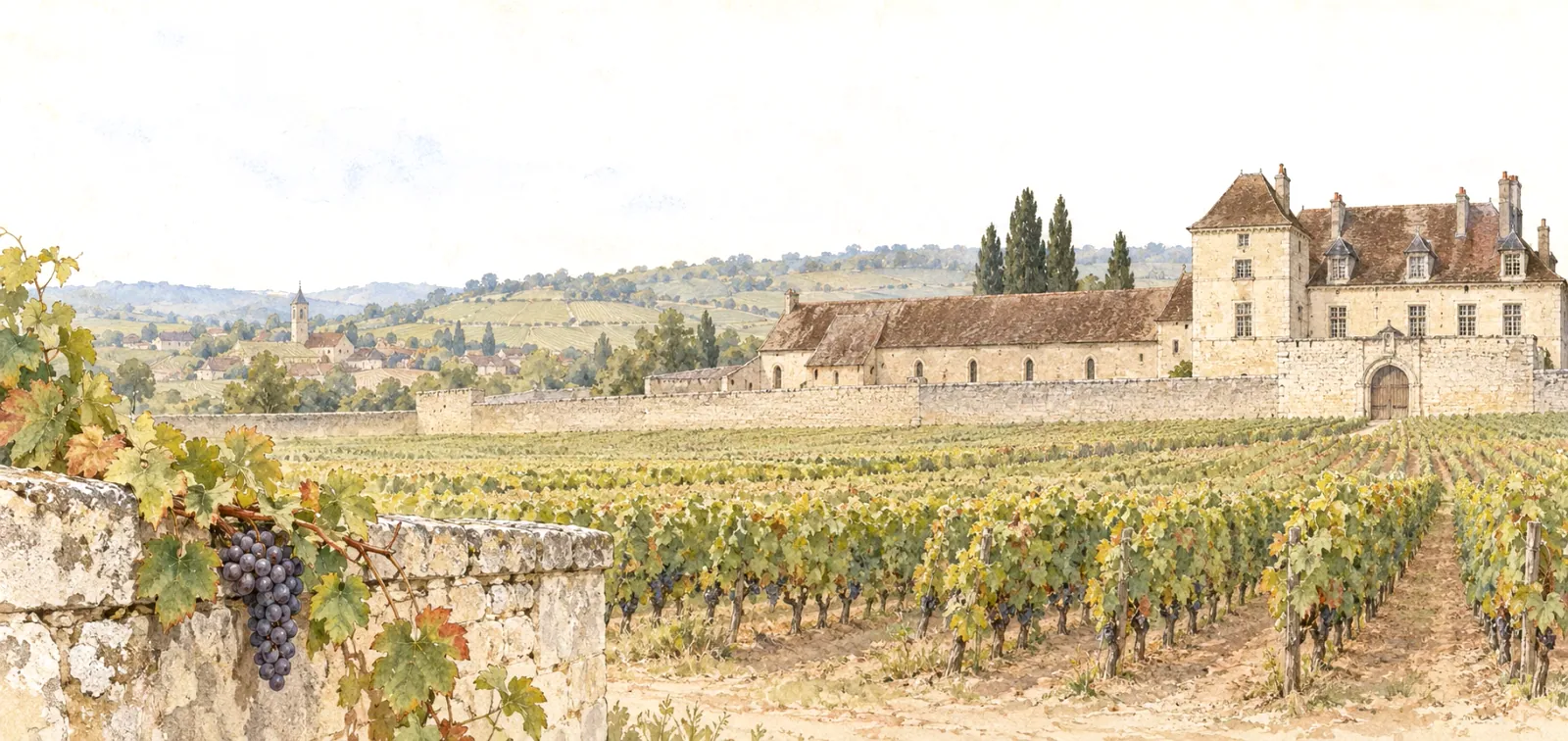
The rest of the wine world followed France. Phylloxera was recorded in Portugal in 1865, Switzerland in 1871, Austria in 1872, California in 1873, Germany in 1874, Australia and Hungary in 1875, Spain in 1877, Italy in 1879, South Africa in 1880 and Argentina in 1888, among others. In Champagne, growers and houses founded a joint association in 1898 to replant on American rootstock. The crisis also touched famous estates: it was one of the reasons the Clos de Vougeot was sold and broken up in 1889 (see the Cistercians and the Clos de Vougeot).
France had largely replanted on grafted vines before the First World War. Breeders such as Couderc, Millardet, Foëx and Castel produced rootstocks still planted today. More than 80 % of the world's vineyards now use grafted plants, and most of them rest on a handful of rootstocks derived from very few wild vines. Own-rooted vineyards survive where the insect has not arrived, as in Cyprus, or where sand, flooding or climate hold it back, as in parts of Washington State, Armenia and Argentina. The genome authors note that later outbreaks followed when rootstocks failed. Phylloxera is not a closed chapter.
How it connects
Place
- related Southern Rhône In preparation
Story
Continue exploring
- CountryFrance162 entries in the atlas so far
 StoryThe Cistercians and the Clos de VougeotVougeot, France
- Wine regionBordeauxBordeaux, France
 RecipeCassouletCastelnaudary, France
- Wine regionChampagneReims, France
- Wine regionLanguedocNîmes, France
 RecipeCèpes à la bordelaiseBordeaux, France
 StoryThe 1855 Bordeaux classificationBordeaux, France
 StoryDid Dom Pérignon invent Champagne?Hautvillers, France
 StoryThe Judgment of Paris, 1976Paris, France